DOJ Bulk Data Rule
- Proposed Transaction/Agreement Assessment
- Contract Language
- Bulk Data Rule FAQs
Use the decision trees below to assess a proposed transaction or agreement for compliance with the DOJ Bulk Data Rule.
Note: The following decision trees are not intended to precisely summarize the Bulk Data Rule, which you are encouraged to review in full. In case of any discrepancies between the information on this page and the Bulk Data Rule, the Bulk Data Rule controls. The information on this page is a tool to help you determine whether your project may be subject to the Bulk Data Rule. Please reach out to ethicsandcompliance@ucsd.edu with questions.
Assess the receiving party before the transaction.
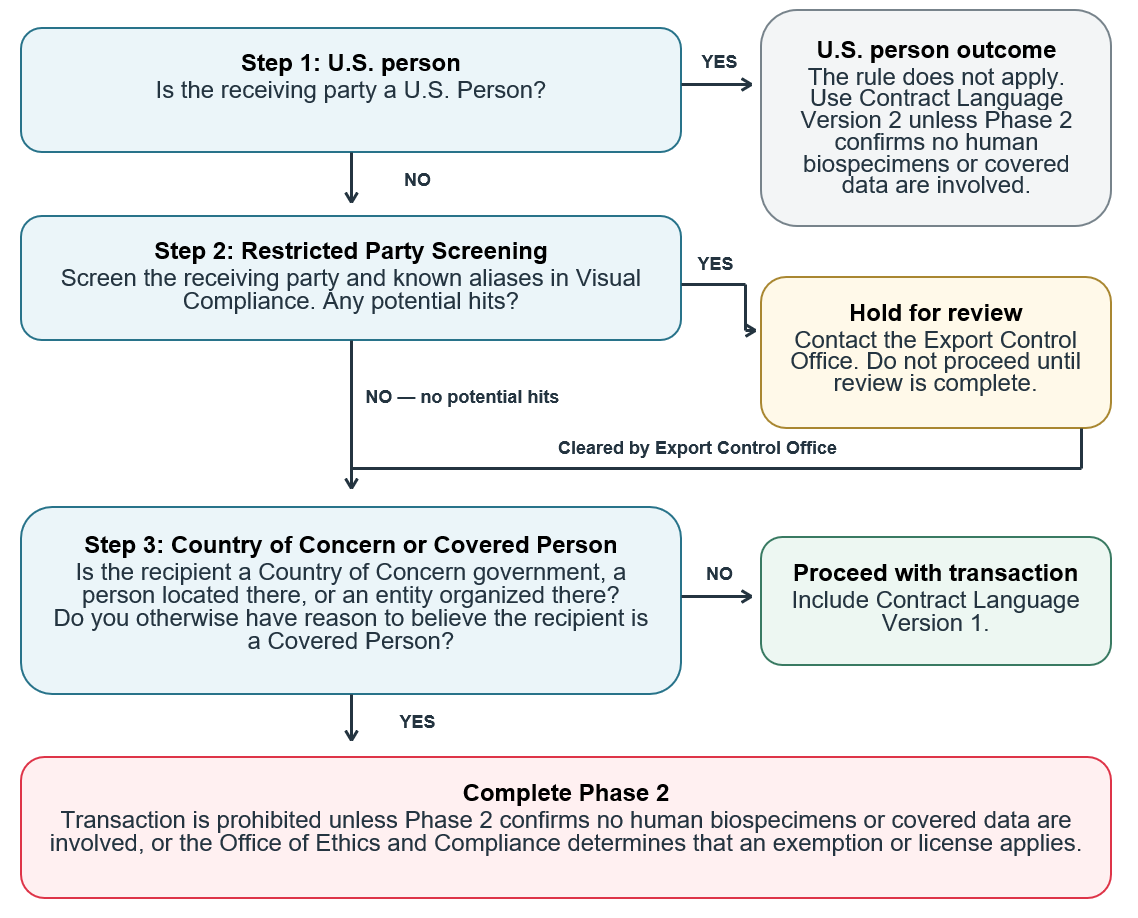
Is the receiving party a U.S. Person?
YES: The rule does not apply; proceed with the transaction using Contract Language Version 2, unless you complete the Phase 2 Decision Tree and determine that the agreement does not involve the transfer of human biospecimens, U.S. Sensitive Personal Data, or U.S. Government-related Data.
NO: Proceed to step 2
U.S. Person: Any U.S. citizen, national, or lawful permanent resident; any individual admitted as a refugee or granted asylum; any entity organized under U.S. laws (including foreign branches); or any person located within the United States, regardless of citizenship (including foreign visitors physically present on campus).
Screen the receiving party (including any known aliases) through Visual Compliance, are there any potential hits?
YES: Contact the Export Control Office for further review; the transaction cannot proceed until the review is complete.
NO: Proceed to step 3
Is the receiving party the government of a Country of Concern, a person located in a Country of Concern, or an entity organized in a Country of Concern? Do you otherwise have reason to believe the receiving party is a Covered Person?
YES: Transaction is prohibited unless you complete the Phase 2 Decision Tree and determine that the agreement does not involve the transfer of human biospecimens, U.S. Sensitive Personal Data, or U.S. Government-related Data; or if in consultation with the office of Ethics and Compliance it is determined that the transaction fits within an exemption or license.
NO: Can proceed with transaction, must include Contract Language Version 1.
Country of Concern: Foreign governments designated by the U.S. Attorney General as posing a significant risk to national security. These currently include: China (including Hong Kong and Macau), Russia, Iran, North Korea, Cuba, and Venezuela.
Covered Person:
Analysis under this phase is only required if receiving parties were determined to be Covered Persons or Countries of Concern under Phase 1. It may also be utilized to determine that contractual language is not needed.
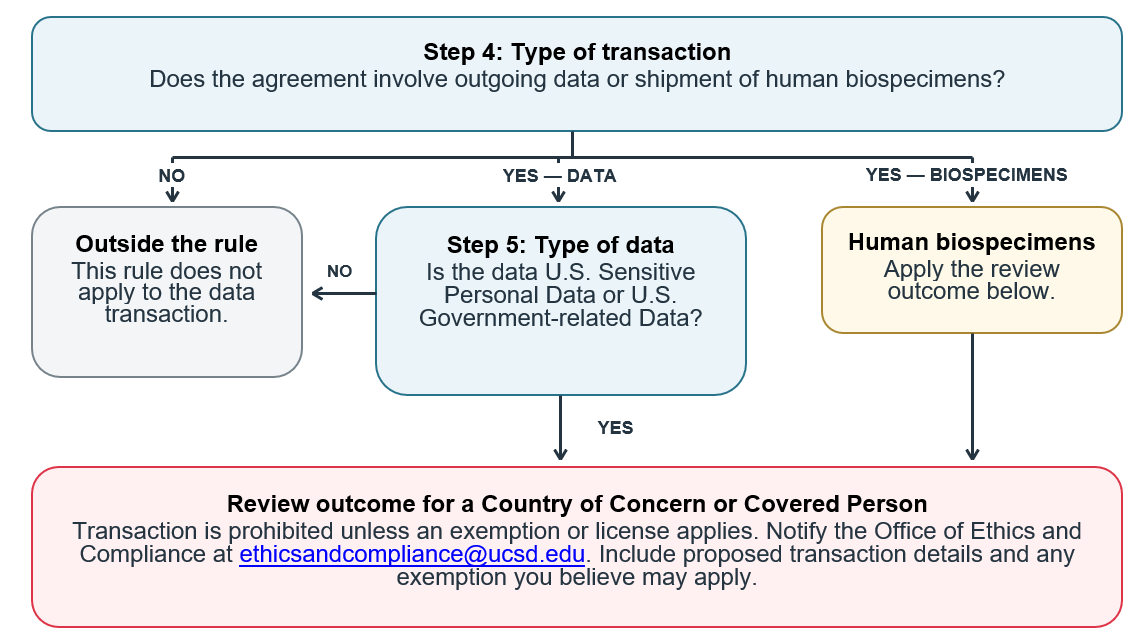
Does the agreement involve outgoing data or shipment of human biospecimens?
YES - data: Proceed to step 5
YES – human biospecimen: If receiving party is a Covered Person or Country of Concern this transaction is prohibited unless it falls into an exemption or license. Please notify the Office of Ethics and Compliance ethicsandcompliance@ucsd.edu of the details of the proposed transaction and whether you believe an exemption may apply.
NO: This rule does not apply to your data transaction.
Human Biospecimens: A quantity of tissue, blood, urine, or other human-derived material.
Is the data U.S. Sensitive Personal Data or U.S. Government-related data?
YES: If receiving party is a Covered Person or Country of Concern this transaction is prohibited unless it falls into an exemption or license. Please notify the Office of Ethics and Compliance ethicsandcompliance@ucsd.edu of the details of the proposed transaction and whether you believe an exemption may apply.
NO: This rule does not apply to your data transaction.